








When you need qualified leads and paying customers fast, paid ads are the most effective path forward. While platforms like Facebook, Instagram, LinkedIn, and Pinterest are great, they are mostly expensive and highly competitive. YouTube video ads stand out as one of the most cost-effective and least crowded paid ad channels available today. We will discuss why YouTube Video Ads are so useful. YouTube viewers are 2x more likely to purchase a product after seeing it advertised on the platform. With roughly 2.7 billion active monthly users globally, YouTube gives you access to a vast and diverse audience.
YouTube Ad Formats
- Skippable In-Stream Ads – You only pay if a viewer watches at least 30 seconds (or interacts with the ad).
- Non-Skippable In-Stream Ads – Short, required ads charged on a cost-per-thousand-views (CPM) basis to guarantee brand exposure.
- Bumper Ads: Brief and 6-second non-skippable ads designed for quick recall.
- In-Feed (Discovery) Ads: Text and image ads that appear at the top of YouTube search results.
- Sponsored Cards & Overlays: Interactive pop-ups or bottom banner ads displayed during video playback.
As YouTube operates as both a video platform and the world’s second-largest search engine, viewers mostly land on videos looking for specific solutions rather than casually scrolling.
How to Set Up a High-Converting YouTube Ad Campaign
Running YouTube ads doesn’t need to be complex. Success comes down to combining smart targeting with clear, engaging video assets.
Key Best Practices
Upload Before Launching:
Always host your video content on YouTube (unlisted or public) before setting up your campaign in Google Ads.
Hook Viewers in 5 Seconds:
For skippable ads, solve a problem or show a strong visual hook in the first 5 seconds to stop viewers from skipping.
Mix Your Ad Formats:
- Skippable Ads: Great for direct sales and leads (you only pay for full views or clicks).
- Non-Skippable & Bumper Ads (6 sec): Best for guaranteed brand exposure and quick recall.
- In-Feed / Discovery Ads: Ideal for promoting long-form videos right in search results.
Test & Combine:
Run multiple video lengths and formats together to see which delivers the lowest cost per customer.
Step-by-Step Setup Guide
Step 1: Set Campaign Basics
- Name & Budget – Give your campaign a clear name and set a daily spending limit.
- Schedule & Location – Choose your start/end dates, along with your target country and language.
- Content Safety – Exclude sensitive content categories to protect your brand image.
Step 2: Define Your Target Audience
- Build Personas – Select age, gender, location, and interests that match your ideal buyer.
- Save Segments – Name your audience groups so you can reuse and remarket to them later.
Step 3: Add Details & Launch
- Keywords & Topics – Choose relevant search terms and video categories so your ads appear on related content.
- Add Links & Headlines – Insert your website URL, a compelling headline, and a clear Call to Action (CTA) button.
- Launch – Click Create Campaign to send your ad into review!
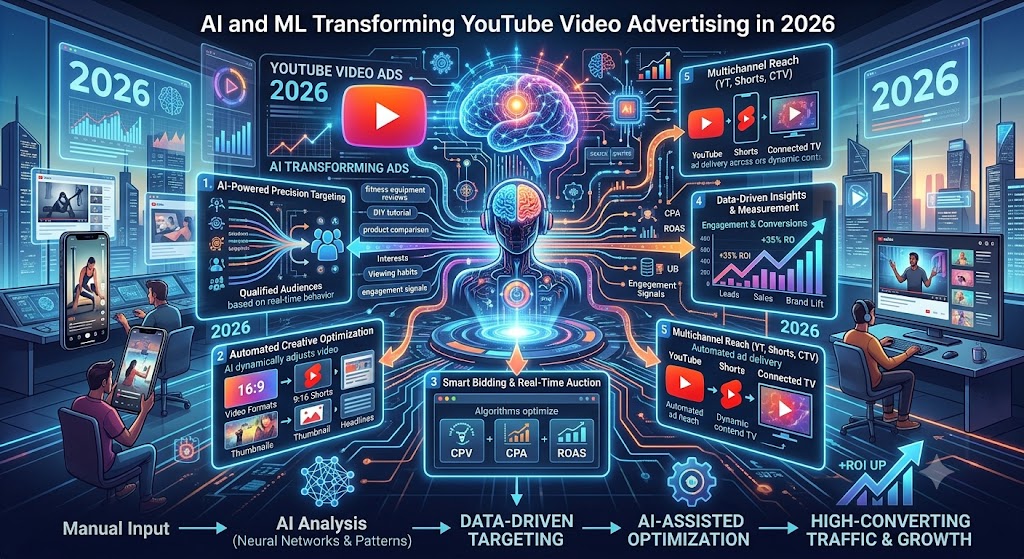
How do AI and Machine Learning transform YouTube Video Advertising in 2026
Digital advertising is no longer driven only by keywords, demographics, and manual campaign settings in 2026. Artificial intelligence (AI) and machine learning (ML) are changing how businesses create, target, optimize, and measure advertising campaigns. Among the major advertising platforms, YouTube has become an important channel for businesses that want to combine video content with AI-powered audience targeting.
YouTube advertising is not simply about showing a video to as many people as possible. Modern campaigns can use signals such as user interests, viewing behavior, search activity, content engagement, and conversion data to identify audiences that are more relevant to a business. This makes YouTube video Ads interesting for businesses looking for qualified traffic, leads, sales, and brand awareness.
How is AI Changing YouTube Advertising
Traditional advertising often required marketers to manually select audiences, placements, keywords, budgets, and bidding strategies. AI is changing this process. Google’s advertising systems can use machine learning to analyze large amounts of campaign and user data. These systems can help advertisers identify patterns that are difficult to detect manually.
For example, an advertiser selling fitness equipment may start with broad audience signals. Machine learning can then analyze which users are more likely to watch the advertisement, visit the website, sign up, or purchase a product. The campaign can use these signals to optimize delivery toward users who are more likely to complete the desired action. This creates a shift from: Manual targeting → Data-driven targeting → AI-assisted optimization
Why YouTube Video Ads Matter in 2026
YouTube combines video, search behavior, content discovery, and audience engagement. Users visit YouTube for many different reasons. They search for tutorials, product reviews, entertainment, educational content, demonstrations, comparisons, news, and solutions to specific problems. This creates different advertising opportunities. A business can use video ads to introduce a product, demonstrate how it works, answer customer questions, explain a service, or build brand awareness.
The objective is not necessarily to make every viewer buy immediately. A successful campaign can move users through different stages: Awareness → Interest → Consideration → Action → Retention
AI and machine learning can help advertisers optimize campaigns according to these objectives.
AI-Powered Audience Targeting
The biggest advantage of modern digital advertising is the amount of behavioral data available to advertising systems. Instead of relying only on age, gender, or location, advertisers can use broader audience signals and allow machine learning systems to identify users who are more likely to respond to the campaign. For example, an online software company could advertise its product to people interested in-
- Business software
- Digital marketing
- Productivity tools
- AI automation
- Small-business technology
- Online collaboration
- Business growth
Machine learning can then help identify patterns among users who interact positively with the advertisement. This can make audience targeting more dynamic than traditional demographic advertising.
How Can AI Help Create Better Video Ads
AI is also changing the creative side of YouTube advertising. Marketers can use AI tools to support:
- Video script development
- Headline generation
- Storyboarding
- Voiceovers
- Caption creation
- Video editing
- Translation
- Personalization
- Creative testing
- Content repurposing
However, AI should not replace the entire creative process. A generic AI-generated advertisement can easily look similar to thousands of other advertisements. The strongest campaigns still require a clear understanding of the customer, a compelling message, authentic creative direction, and a strong reason for the viewer to take action. AI should function as a creative and analytical assistant, rather than simply becoming a content-production shortcut.
YouTube Advertising Strategy & Cost Blueprint
YouTube operates as the world’s second-largest search engine, meaning viewers visit the platform with high intent—actively seeking tutorials, product reviews, and solutions. Converting this traffic effectively relies on combining strong content practices with an understanding of modern ad costs.
Core Strategy for YouTube Advertising
1. Build an Engaging Channel Foundation
- Maintain Consistent Branding – Ensure your channel banners, logos, and thumbnails clearly communicate your core value proposition.
- Diversify Video Formats – Produce product demos, customer testimonials, and quick FAQ videos to build credibility before driving paid traffic.
- Leverage Customer Reviews – Feature social proof and genuine customer feedback directly in your video assets to build immediate trust.
2. Optimize Campaigns & Audience Targeting
- Use Remarketing: Direct specialized ads to users who have previously visited your website, subscribed to your channel, or interacted with your content.
- Continuously A/B Test: Test multiple creative hooks, video lengths, and call-to-action (CTA) variations to refine campaign performance over time.
- Track Lift Metrics: Measure ad impact beyond immediate conversions by running Brand Lift Studies to evaluate search lift and brand awareness
How Cheap Are YouTube Ads?
YouTube video ads operate primarily on a Cost-Per-View (CPV) or Cost-Per-Mille (CPM) bidding model rather than standard pay-per-click setups. You catch visitors at the exact moment they are looking for information about your product or service, leading to much higher-quality leads.
Average Cost-Per-View (CPV):
For skippable in-stream ads, views typically cost between $0.03 and $0.12 USD.
“Free Exposure” Advantage:
With Skippable In-Stream ads, you are charged only when a viewer watches for 30 seconds or longer (or clicks your CTA). If a viewer watches 20 seconds of your ad and skips, your brand message is delivered at zero ad cost.
YouTube Shorts Advantage:
Short-form vertical ads offer some of the lowest CPM rates across visual media networks, providing a cost-effective entryway to test visual creative.
Less Crowded:
You face a lot less competition on YouTube compared to Facebook. This means you have more open opportunities and it’s easier to get your ad seen by your target audience.
High User Intent (Targeting Power): The biggest difference is user intent.
Facebook Vs YouTube:
Users are scrolling to see what friends are doing. Your ad is an interruption, trying to divert their attention from posts about food, family, or news. Users are actively searching for something specific: a tutorial, a product review, a workout routine. Your ad appears when they are already engaged with a related topic.
First Few Seconds Still Matter
YouTube users can quickly lose interest in an advertisement. So the opening section of a video needs to communicate the message’s value quickly. Instead of beginning with a long company introduction, businesses can start with:
- A problem – “Are your advertising costs increasing?”
- A question – “How much are you spending to acquire one customer?”
- A result – “Here is how businesses are using AI to reduce manual marketing work.”
- A demonstration – “Watch how this AI system analyzes your campaign data.”
AI can help marketers generate and test different hooks, but human judgment is still important when deciding which message represents the brand accurately.
YouTube advertising has evolved far beyond a place to boost video views. It is now the single most cost-effective search engine for high-intent traffic. It combines precise intent targeting, lower competition, and a billing model that rewards you with free exposure on skipped views; YouTube gives businesses a distinct competitive edge over crowded social feeds. When executed strategically, YouTube ads bridge the gap between building brand awareness and driving direct leads. This allows you to scale your customer base predictably while keeping acquisition costs under control.