







How would you describe GEO VS SEO? Many people believe that GEO (Generative Engine Optimization) is replacing SEO. That is not true. GEO is not replacing SEO. GEO is building on top of SEO. SEO and GEO work together. The GEO VS SEO is the most accurate and strategically sound pairing. It cleanly pits the traditional click-and-visit model (SEO) against the modern citation-and-recommendation AI model (GEO). Google SEO vs LLM SEO is highly descriptive and intuitive.
A layperson, business owner, or traditional marketer might not know what “GEO” stands for yet, but they instantly understand the differences between Google and an LLM. “GEO vs SEO” as your primary signal, topical authority to both Google’s crawlers and AI parsing engines. For a deeper analysis of how optimisation frameworks change when moving between traditional search algorithms and generative models, this breakdown of SEO and GEO optimization methods offers a practical look at the specific tactics.
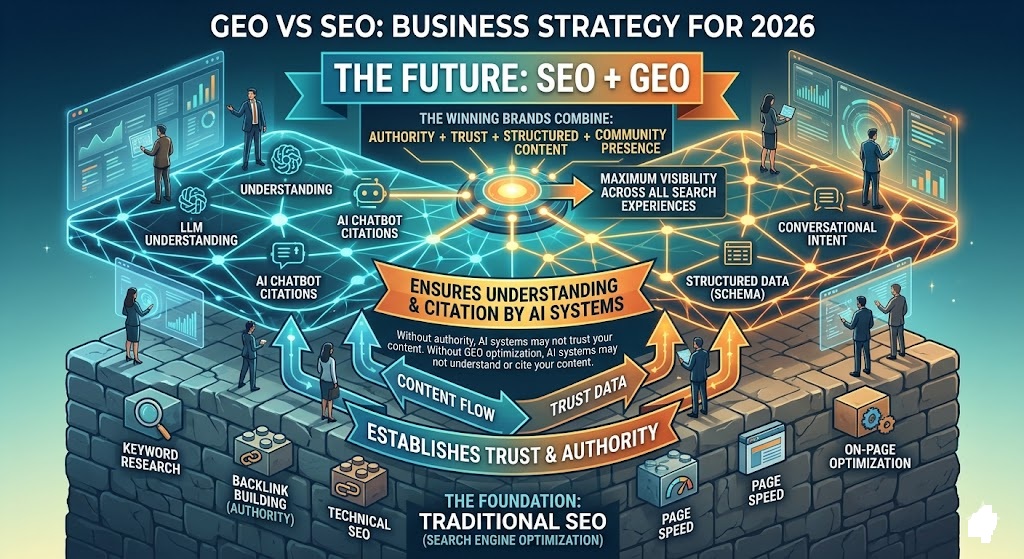
TRADITIONAL SEO LAYER
Targets: Search Engine Crawlers (Google, Bing)
Primary Goal: Clicks, Impressions, & SERP Rankings
Mechanics: Domain Authority, Backlinks, Technicals
MODERN GEO LAYER
Targets: Large Language Model Parsers & LLM Context
Primary Goal: Citations, Mentions, & Ecosystem Consensus
Mechanics: Content Structure, Brand Stories, Off-Site PR
WHAT IS SEO?
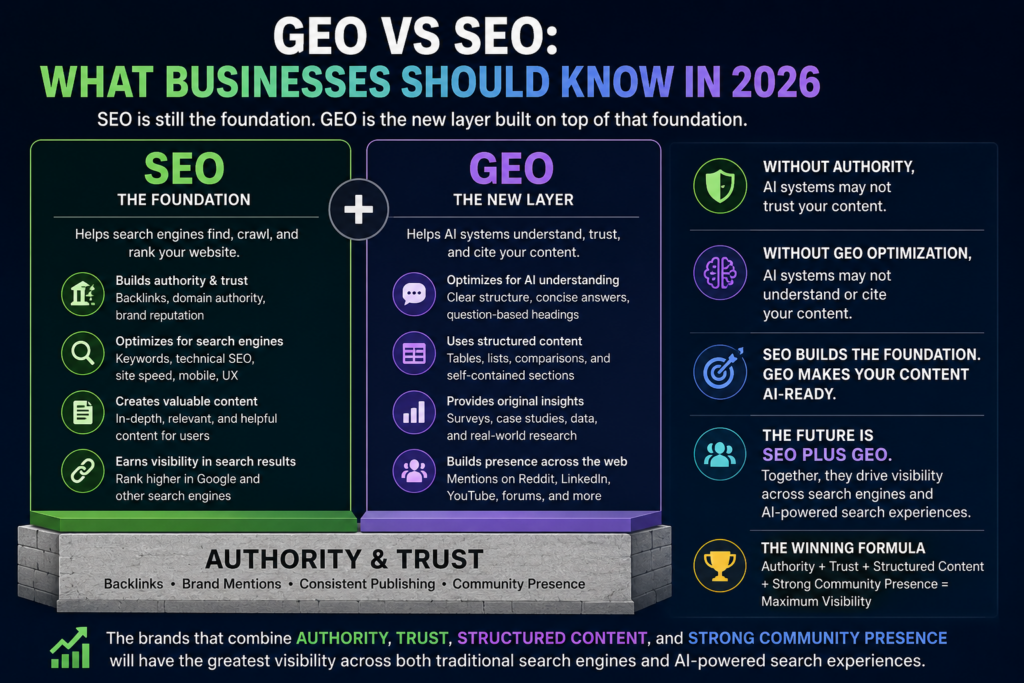
SEO helps websites rank in search engines like Google. It focuses on-
1. Website speed 2. Mobile friendliness 3. Technical optimization 4. Keyword research
5. Content creation 6. Link building 7. User experience 8. Authority and trust
SEO helps search engines discover and rank your website.
WHAT IS GEO?
GEO stands for Generative Engine Optimization. It focuses on helping AI tools like ChatGPT, Google AI Overviews,
Claude, and Perplexity understand and cite your content. GEO is about visibility inside AI-generated answers. Instead of
fighting for clicks, you are competing for mentions and citations.
BIGGEST GEO MYTH
Many marketers believe AI tools rank the best content. In reality, AI systems often look for patterns and consensus. They analyse large amounts of information and identify the answer that appears to be the most commonly supported. This means visibility is influenced by what people are saying across the web, not just what is published on your website.
WHY SEO STILL MATTERS
AI models do not magically trust every website. They often rely on signals that traditional SEO has built for years-
Strong domain authority
High-quality backlinks
Brand recognition
Consistent publishing
Expert reputation
Mentions across the web
A website with no authority may publish excellent content but still struggle to be cited.
WHY GEO MATTERS
Once authority is established, GEO helps make content easier for AI systems to understand and use. Some GEO best practices
include-
Answer Questions Directly – Put the answer near the beginning of the content. Avoid making readers search for the main point.
Use Clear Headings – Question-based headings help AI systems identify relevant information
Keep Sections Self-Contained – Short and focused sections are easier for AI systems to extract and cite.
Add Tables and Comparisons – AI tools often prefer structured information. Comparison tables help summarize key differences quickly.
Publish Original Data – Surveys, case studies, research, and real-world data are more likely to earn citations than generic articles.
AI VISIBILITY HAPPENS BEYOND YOUR WEBSITE
Many AI-generated answers pull information from-
Reddit discussions
LinkedIn posts
YouTube videos
Industry forums
Review websites
Community discussions
People are discovering brands through conversations, not just company websites. That is why building a strong presence across
multiple platforms is becoming increasingly important.
DIFFERENCE BETWEEN GOOGLE SEARCH AND AI SEARCH
Google search tries to find the best page for a query. AI search tries to generate the best answer from everything it has learned. These are different goals. A page ranking #1 in Google may not appear in an AI answer. Likewise, a brand mentioned frequently across communities may appear in AI responses even if its website does not rank at the top of Google. The fundamental difference lies in how these systems choose their winners-
Google asks: “Which individual document best matches the technical intent of this keyword query?” You can buy, optimize, and link-build your way to the top of this list.
An LLM asks: “What does the collective internet, on balance, seem to think is true about this brand or topic?” LLMs do not “rank”—they cite and summarize.
Winning Strategy for 2026
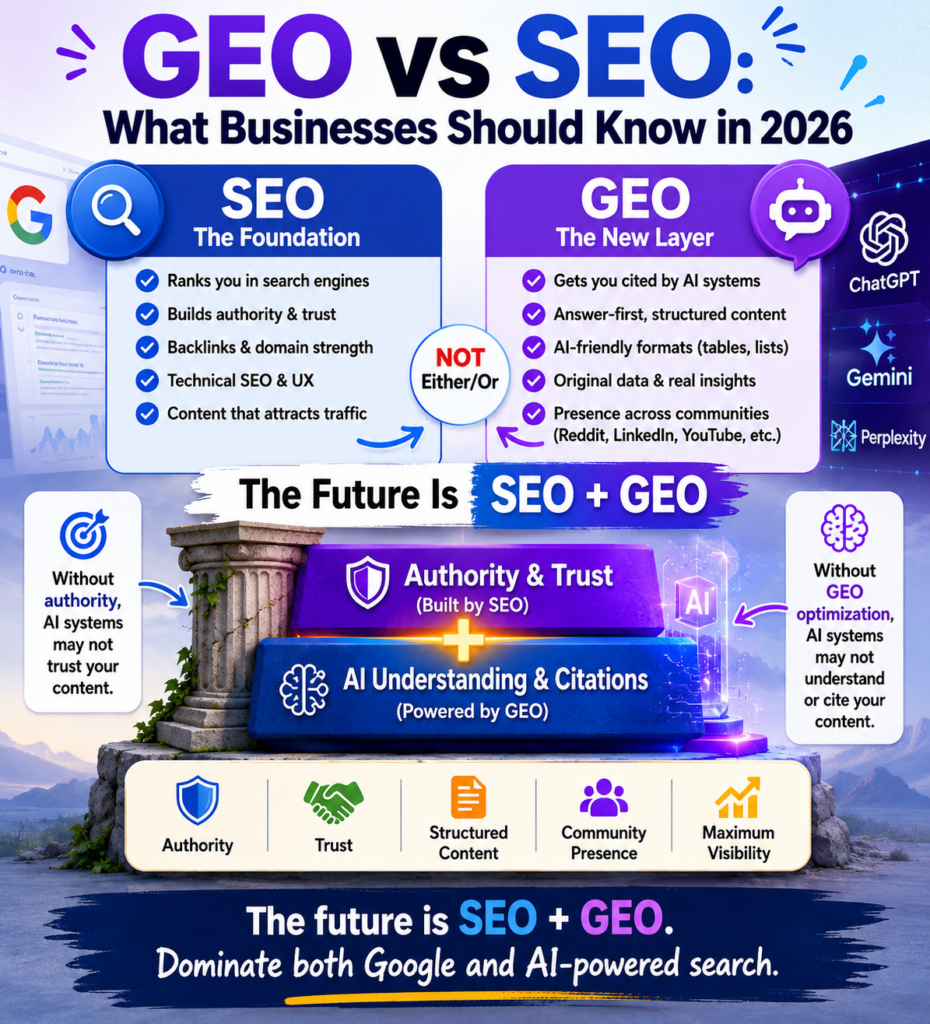
The most successful brands are not choosing between SEO and GEO. They are investing in both.
Build Authority
Earn backlinks
Build partnerships
Get mentioned by trusted sources
Create valuable content
Create AI-Friendly Content
Answer questions clearly
Use structured formatting
Add tables and lists
Publish original research
Build Brand Presence Everywhere
YouTube
Industry communities
Review platforms
Social media
Maximizing Your Analytics
When auditing performance, look past basic surface traffic. Use your analytics platforms to measure whether your traffic is high-
intent by tracking these ten core metrics-
Organic Users & Sessions: The absolute baseline volume of unique visitors arriving via search.
Engaged Sessions & Engagement Rate: The percentage of visitors who interact with your layout rather than immediately
bouncing, proving alignment with search intent.
Average Engagement Time: The depth of user attention, indicating whether your content solved their problem.
Top Organic Landing Pages: Identifying your highest-performing assets so you can clone their structure.
New vs. Returning Visitors: Evaluating your top-of-funnel reach versus your brand stickiness.
Traffic Trends Over Time: Checking MoM and YoY vectors to isolate algorithm shifts from seasonal changes.
Conversions & Revenue from Organic Traffic: The ultimate measure of marketing ROI—tracking purchases, sign-ups, and
pipeline generated directly by organic search.
Part Framework to Win at GEO
To ensure your brand is cited when users query an LLM, implement these six tactical content shifts:
Structure Content for Easy Extraction
AI parsers scan for quick, modular answers.
Organize your pages with direct, question-based headings.
Write in self-contained, 50-150-word chunks.
State your thesis or answer directly within the first 50 words of a section.
Deploy Comparison Tables & Lists
LLMs are inherently built to organize and structure data for users.
Use clear Markdown tables for product or service comparisons; pages with structured comparisons earn roughly 32% more AI citations.
Use bulleted or numbered lists for step-by-step processes to fit seamlessly into summarized AI answers.
Force Distributed Consensus Off-Site
Because LLMs are fundamentally consensus engines, 85% of brand mentions originate from third-party sites. Your own domain
cannot carry your brand authority alone.
Distribute your brand story across forums, directories, “best of” review lists, and interviews.
If dozens of independent voices across Reddit, YouTube, LinkedIn, and industry blogs point in the same direction, the
model internalizes that narrative as a baseline truth.
When it comes to the GEO Vs SEO debate, SEO is still the foundation. GEO is the new layer built on top of that foundation. Without authority, AI systems may not trust your content. Without GEO optimization, AI systems may not understand or cite your content. The future is SEO plus GEO. The brands that combine authority, trust, structured content, and strong community presence will have the greatest visibility across both traditional search engines and AI-powered search experiences.