



Search is undergoing its biggest transformation in decades.
For years, SEO success was measured by one primary metric that is ranking on Google’s first page. Today, users increasingly search through AI-powered platforms like ChatGPT, Perplexity, Claude, Gemini, and Google’s AI Overviews before visiting traditional search results.
This shift doesn’t mean traditional SEO is obsolete or disappearing. Instead, it expands the definition of organic search and SEO for AI Search
The objective is no longer limited to earning a click from a search engine. Modern brands must become reliable sources that AI systems recognize, trust, and reference when generating answers.
AI Search and Changing User Behavior
Unlike conventional search engines that display a list of links, AI search engines synthesize information from multiple trusted sources into a single response. Users increasingly expect-
- Direct answers instead of multiple search results
- Personalized recommendations
- Comprehensive comparisons
- Conversational interactions
- Faster decision-making
As AI assistants continue to gain adoption, visibility depends less on occupying a specific ranking position and more on becoming a trusted information source.
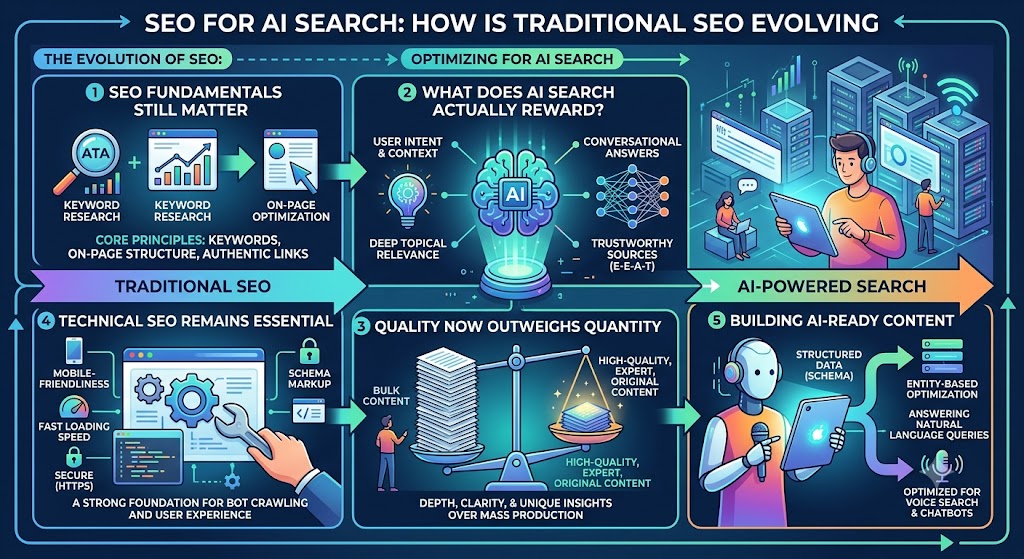
SEO Fundamentals Still Matter
The biggest misconception surrounding AI search is that it requires an entirely new optimization strategy.
In reality, Google’s AI Overviews and AI Mode continue to rely on the same underlying ranking systems that power traditional Search.
That means AI systems still depend on websites that are-
1.Technically accessible
2. easy to crawl and index
3. Well-structured
4. Relevant to search intent
5. Demonstrably trustworthy
AI does not replace SEO. It builds upon it. The strongest AI visibility typically belongs to websites that already demonstrate strong SEO fundamentals.
What Does AI Search Actually Reward
Many businesses focus on technical shortcuts such as-
llms.txt
Schema markup alone
Markdown pages
AI-specific formatting
Prompt engineering
While these can support discoverability, they are rarely the deciding factor. AI search systems consistently prioritize broader trust signals, including-
Strong topical authority
Expert-written educational content
High-quality backlinks
Consistent brand mentions
Industry publications
Customer reviews
Community discussions
YouTube videos
Comparison pages
Reliable internal linking
Entity consistency across the web
AI prefers sources that have earned credibility rather than being optimized for algorithms.
Growing Importance of Entity Authority
The most significant development in SEO for AI search is the growing role of entities.
An entity is a clearly identifiable person, company, product, or organization that search engines can distinguish from similar concepts.
Brands with generic or keyword-heavy names mostly struggle because search engines may interpret those names as informational queries rather than navigational searches.
Here is the core trap most brands fall into – if your brand name resembles a keyword, AI will treat it as a keyword.
If your site is named something generic, like “top web online dot com,” Google and AI models assume the user is looking for general information, not your specific homepage.
AI models don’t ask, “Which site has this name?” They ask, “Which entity best answers this question?”
If your brand looks interchangeable with 500 other sites, you become a non-factor. This is why sites get crawled and used for data without ever being named or getting the click. The AI understands the topic, but it doesn’t recognize you as an entity.
For example,
A. “Axiom Analytics” is easier to identify as a unique organization.
B. ” Top Web Online” resembles a generic keyword phrase.
When a brand lacks entity clarity:
A. Google may not recognize branded searches as navigational.
B. AI systems struggle to associate content with the organization.
C. Competitors with stronger entity signals may receive citations instead.
D. Be consistently referenced across trusted third-party sites, forums, and publications.
E. Map cleanly to a real-world entity, not a generic keyword bucket.
Entity recognition increasingly influences how AI attributes information.
From Rankings to Citations
Traditional SEO focused on visibility within search results. AI search introduces another layer of competition-
Can your content be cited inside AI-generated answers?
Citation likelihood depends on several factors.
1. Entity Authority
AI favors organizations with established credibility across multiple trusted sources.
2. Semantic Coverage
Content should answer an entire topic comprehensively instead of targeting isolated keywords.
3. Citation-Friendly Structure
Clear headings, concise explanations, definitions, lists, and comparisons make content easier for AI systems to extract accurately.
4. Machine Readability
Logical HTML structure, clean formatting, descriptive headings, and well-organized pages help AI interpret information efficiently.
New SEO Stack
Modern organic visibility extends beyond conventional optimization.
Today’s strategy increasingly combines multiple disciplines:
SEO (Search Engine Optimization)
Builds technical health, keyword relevance, backlinks, and rankings.
GEO (Generative Engine Optimization)
Improves the likelihood of being cited by AI-generated responses.
AEO (Answer Engine Optimization)
Optimizes content for direct answers within AI Overviews and voice search.
SXO (Search Experience Optimization)
Enhances usability, trust, engagement, and conversions after users discover the brand.
These approaches complement one another rather than compete.
Content Depth Is Becoming a Competitive Advantage
AI search systems frequently break complex user questions into multiple related subtopics before generating responses.
For example, a search for enterprise payroll software may involve-
Pricing
Compliance
Industry use cases
Integrations
Security
Customer support
Alternatives
Implementation
A single generic landing page rarely satisfies all these dimensions.
Brands that publish comprehensive, interconnected resources across the customer journey provide AI with more opportunities to retrieve relevant information.
Quality Now Outweighs Quantity
Publishing large volumes of shallow content is becoming less effective.
Instead, successful organizations emphasize-
Original insights
First-hand expertise
Updated research
Practical examples
Comprehensive topic coverage
Expert commentary
Real customer experiences
As AI becomes better at evaluating information quality, authority compounds over time.
Role of Brand Mentions
AI models evaluate signals from across the web.
These include-
News articles
Industry publications
Expert interviews
Community forums
Product reviews
Podcasts
Educational videos
Independent comparisons
However, not every mention carries equal value.
Authentic editorial coverage and trusted third-party recommendations contribute significantly more than artificial or low-quality brand mentions created solely for SEO purposes.
Technical SEO Remains Essential
Despite the excitement around AI search, technical SEO continues to form the foundation.
Critical elements include-
Crawlability
Fast loading speeds
Mobile usability
Structured internal linking
Clean information architecture
Updated XML sitemaps
Canonical management
Accurate metadata
Without these basics, even excellent content may struggle to gain visibility.
Building AI-Ready Content
Organizations preparing for AI search should focus on-
Answering customer questions comprehensively.
Publishing original research and unique perspectives.
Maintaining a consistent brand identity across digital platforms.
Strengthening topical authority within their industry.
Earning authoritative backlinks naturally.
Updating existing content regularly.
Creating comparison pages, buying guides, FAQs, and implementation resources.
Structuring content so that information can be extracted clearly by AI systems.
AI search or SEO for AI Search represents the next stage of SEO rather than its replacement.
While user behavior is shifting from link-based browsing to AI-generated answers, the underlying principles remain remarkably consistent.
Technical excellence, authoritative content, topical expertise, trustworthy brand signals, and a strong user experience continue to determine long-term visibility.
The difference is that success is no longer measured solely by rankings.
Modern search success increasingly depends on whether AI systems recognize, retrieve, cite, and attribute your content as the most reliable source.
For businesses preparing for the future of organic growth, the winning strategy is not to abandon SEO—but to expand it for an AI-driven search landscape.