





Search is changing. Earlier, people mainly searched on Google or Bing. They used to look at a list of websites and clicked the result they found useful. Today, people are increasingly asking AI systems such as ChatGPT, Gemini, Perplexity, and other AI-powered search tools for direct answers. This change has created a new area of digital marketing called GEO, or Generative Engine Optimization. GEO is about making your website and content easier for AI systems to discover, understand, trust, use, and potentially cite when generating an answer.
Search is no longer just a list of blue links. As Google’s AI Overviews reach billions of users and AI engines like ChatGPT and Perplexity handle complex multi-step queries, search visibility has become a multi-dimensional battleground, and so does GEO for Brand Visibility, GEO Optimization for AI Search, or GEO Strategy for AI Search.
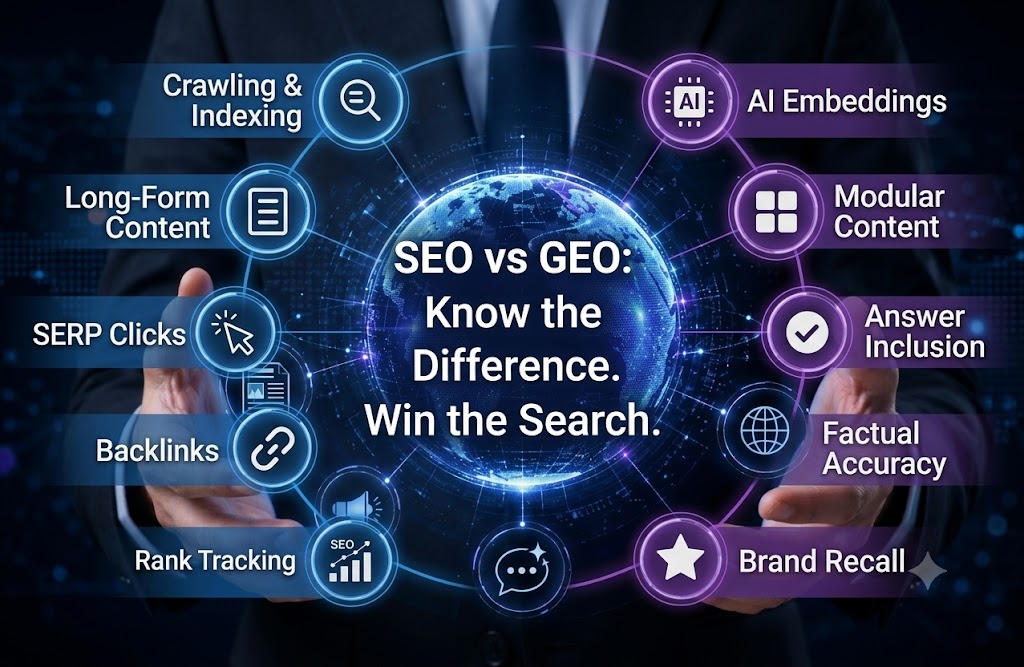
To stay visible, you must master three distinct disciplines: SEO (Search Engine Optimization), AEO (Answer Engine Optimization), and GEO (Generative Engine Optimization).
SEO Vs AEO Vs GEO
Though many marketers treat these terms interchangeably, they operate on vastly different computer science principles, metrics, and goals.
| Optimization Layer1 | Engine Type | Unit of Optimization | Ranking Mechanism | Key Metric | Ultimate Goal |
| SEO (Search Engine) | Google / Bing Classic | Entire HTML Document (URL) | PageRank, backlink authority, title tags, dwell time | SERP Rank (1–10) & CTR | Get the click |
| AEO (Answer Engine) | Voice Assistants, Featured Snippets | Structured Snippet / Micro-Copy | Direct question-matching, schema, concise ~40-word answers | Zero-Click Share & Featured Box | Be the direct answer |
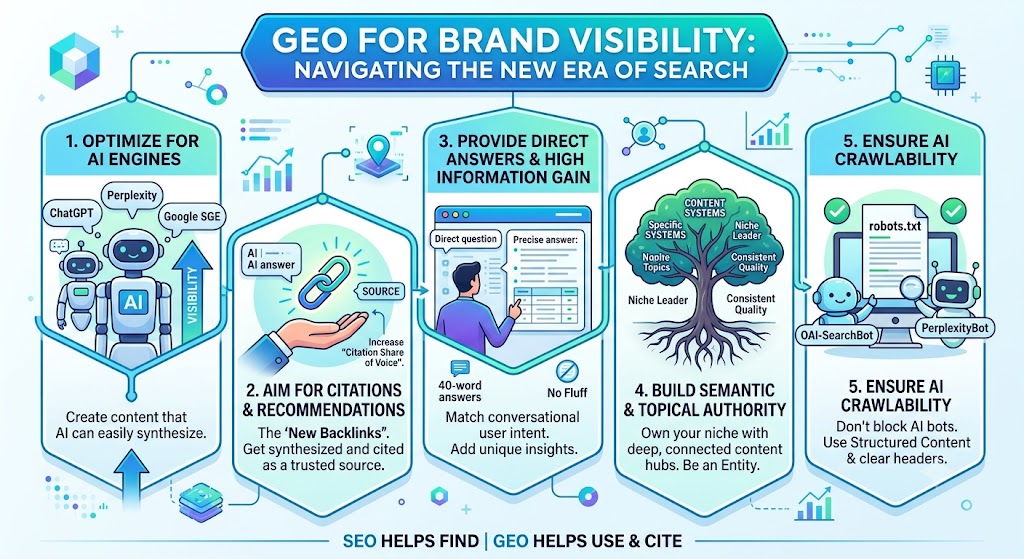
| GEO (Generative Engine) | ChatGPT Search, Perplexity, Claude, Gemini | 300-Token Semantic Vector Chunks | Information gain, entity salience, third-party consensus | Citation Share of Voice (SOV) | Be synthesized & cited |
SEO: Helps Google and Bing find and rank your webpage.
AEO: Helps answer engines find a clear answer from your content.
GEO: Helps AI systems such as ChatGPT, Perplexity, Gemini, and other generative search systems understand your brand and, if appropriate, use or cite your information.
The easiest way to understand GEO
- SEO = Get found
- AEO = Get answered
- GEO = Get mentioned or cited
For example, suppose someone asks:
“What are the best AI tools for a content team?”
With traditional SEO, you want your page to rank high in Google.
With AEO, your page should provide a clear and direct answer.
With GEO, you want an AI system to understand your product, include it in the answer, and potentially cite your website as a source.
3 Basic GEO Layers
1. Access — Can AI reach your website?
Your pages need to be crawlable and accessible.
Check things like:
- Robots.txt
- Server response
- Page accessibility
- Indexing
- Clean HTML
- Internal links
If AI cannot access your content, it cannot use it.
2. Understanding — Can AI understand your content?
Make your website clear about:
- Who you are
- What you offer
- Who you serve
- What topics you cover
- What makes you different
Use clear headings, structured content, relevant entities, author information, and appropriate structured data.
3. Quotability — Can AI easily use your information?
This is very important.
Instead of writing:
“We are committed to suggesting AI tools that will help the content team…”
Say:
“We suggest 5 AI tools such as ChatGPT, Gemini, Claude… for the content team.”
The second sentence is specific, useful, and easy to understand or quote.
What GEO is NOT
When you are going to explain GEO for brand visibility, you need to be clear about misconceptions related to GEO –
GEO is not simply:
❌ Adding an llms.txt file
❌ Repeating keywords
❌ Adding special AI markup
❌ Breaking every paragraph into tiny pieces
❌ Buying hundreds of mentions
❌ Replacing SEO
What GEO actually needs
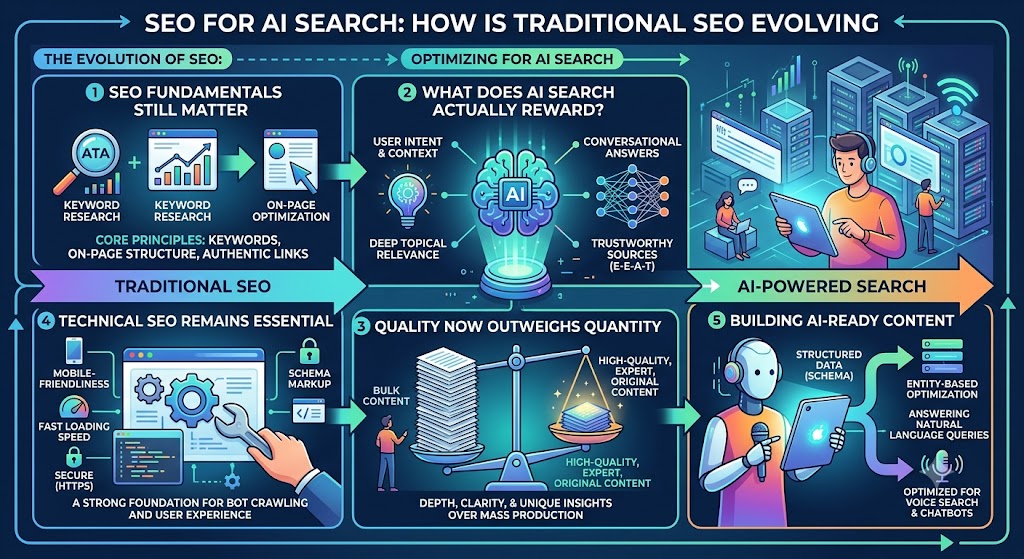
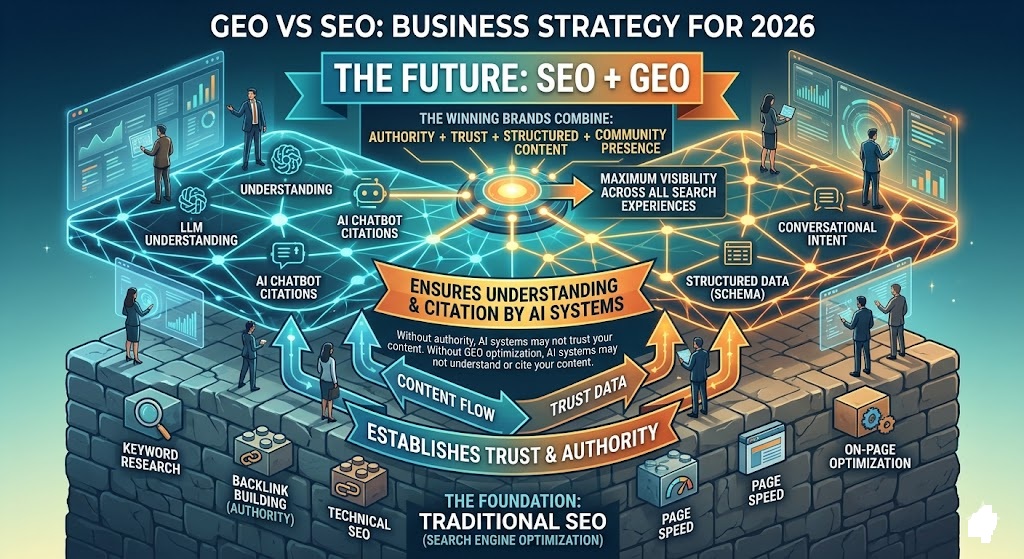
Technical SEO + Quality Content + Topical Authority + Brand Authority + Clear Answers + Credible Sources
That is why I would describe GEO as:
SEO foundation + AI visibility layer
3-Layer Mechanics of GEO
GEO is not a replacement for technical SEO. It is an optimization layer built on top of it. For an LLM to cite your brand, your content must clear three sequential layers-
Access (The Floor)
If AI crawlers are blocked by your robots.txt or restricted by client-side Javascript, your site cannot be retrieved by RAG pipelines.
Understanding (The Context)
Clean semantic HTML, JSON-LD schema, clear headings, and strong entity relationships allow the AI to accurately identify your brand, products, and facts.
Quotability (The Execution)
High information density, concise answers, factual precision, and direct summaries give the AI self-contained passages it can extract and cite inline. GEO makes your content easier for AI systems to discover, understand, evaluate, use, and potentially cite.
Modern Intent: SEO Query vs. GEO Prompt
As search habits transition from keyword queries to conversational prompts and user intent changes shape. Your content strategy must cater to both formats.
Traditional SEO Query : suggesting AI tools that will help the content team
1. User expected: A list of the top AI tools to click.
2. Page requirements: Keyword targets, title tags, standard landing page.
Conversational GEO Prompt
What are the specific AI tools that will be helpful for the cotnent team
1. User expected: A synthesized operational definite number of AI tools for recommendations.
2. Page requirement: Detailed frameworks, clear pros/cons, concise operational answers, and explicit use cases that an LLM can quote.
Myths vs. Reality: What Works in GEO
| THE MYTH | THE REALITY |
| GEO is an entirely new playbook replacing SEO. | Organic ranking is still the ticket. AI search sits on top of classical indexing. If you don’t rank in top search results, RAG rarely finds you. |
Uploading an llms.txt file or “magic schema” guarantees citations. | Search engines and LLMs prioritize domain authority, ranking, and first-hand value, not proprietary shortcut files. |
| Publishing high-volume, generic AI content works for GEO. | Commodity content gets synthesized without credit. Original data, founder insights, and unique experience (E-E-A-T) get cited. |
| You can optimize once for every AI engine. | Different engines weigh sources differently (e.g., Perplexity favors authoritative links and recent news; ChatGPT heavily leverages Bing and Reddit feeds). |
Common GEO Mistakes to Avoid
Writing for Clicks Instead of Answers: Hiding key takeaways behind fluff, intro paragraphs, or clickbait hooks prevents AI systems from extracting the facts they need.
Being Vague About Offerings: Generic messaging (e.g., “We drive digital transformation”) stops AI from confidently matching your brand to specific user needs.
Lacking Verifiable Proof: Unsubstantiated claims get ignored. Back up statements with hard metrics, case studies, and primary research.
Walls of Unformatted Text: Dense paragraphs without clean headers, bullet points, or summary boxes make parsing difficult for LLM chunking algorithms.
Blocking AI Crawlers: Accidentally disallowing web crawlers (such as OAI-SearchBot, PerplexityBot, or Bytespider) in your robots.txt excludes your domain from real-time citation retrieval.
15 Essential Terms You Must Know in 2026
- GEO (Generative Engine Optimization): The practice of making content easy for generative AI engines to retrieve, parse, synthesize, and cite.
- LLM (Large Language Model): The underlying generative AI engine (e.g., GPT-4o, Claude 3.5, Gemini) that powers AI search experiences.
- LLM Sources: Webpages cited by AI models within their generated answers—the primary arena for modern brand exposure.
- AI Overviews: Google’s AI-generated answer panels at the top of search results that summarize web sources and impact top-of-funnel (TOFU) organic traffic.
- Citations: Links embedded directly within synthesized LLM responses. Citations act as the “new backlinks.”
- RAG (Retrieval-Augmented Generation): The technical process by which an LLM fetches real-time web content from an index before generating a response.
- AEO (Answer Engine Optimization): Structuring precise data so AI engines and voice interfaces can extract direct answers with zero ambiguity.
- Perplexity: An AI-native answer engine that blends real-time web browsing, LLM synthesis, and explicit inline citations.
- ChatGPT Search: OpenAI’s web search integration that pulls real-time data from web indices, Reddit, and media partners to synthesize live answers.
- Vector Search: Search powered by semantic intent and contextual meaning rather than exact keyword matching.
- Structured Content: Information organized using distinct headings, bullet lists, bold text, and summary tables that LLMs can cleanly digest.
- AI Snippets: Concise, standalone summaries generated by AI from your content to directly address specific user intents.
- Domain Authority: Overall domain trust and link profile strength, which remain key inputs for LLMs when selecting reliable sources to cite.
- Topical Authority: Comprehensive coverage of a specific niche through hub-and-spoke content structures that signal deep expertise to crawlers.
- Crawlability for AI: Configuring technical infrastructure (e.g.,
robots.txt, static HTML rendering) so AI bots likeOAI-SearchBotandPerplexityBotcan access your pages.