








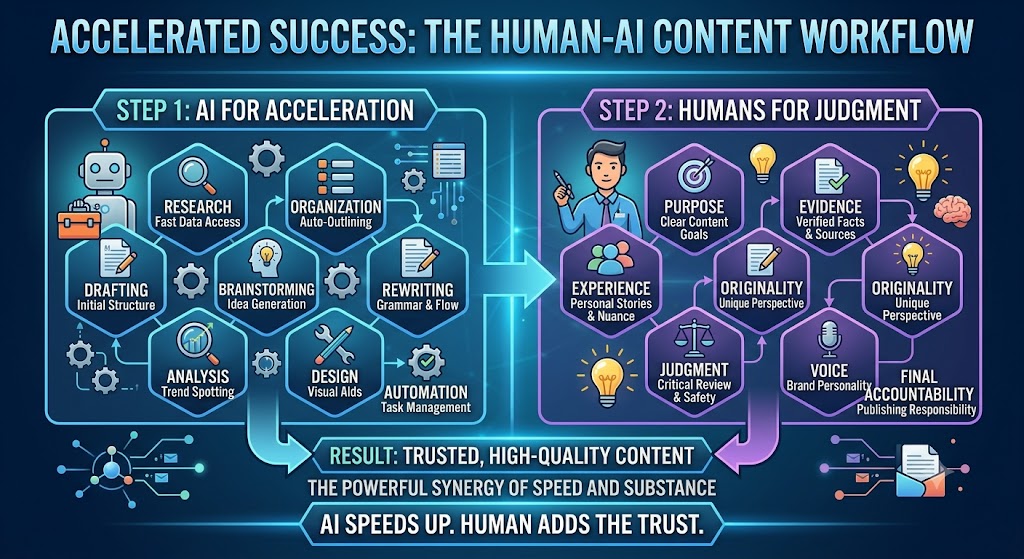
While AI offers unprecedented speed and efficiency, relying on it entirely produces generic, untrustworthy, and underperforming content. High-impact content requires combining AI’s processing power with human judgment, experience, and original thinking. AI can research, draft, rewrite, brainstorm, design, and automate tasks much faster than humans. But more content does not automatically mean better content.
A business can use AI to produce 50 articles instead of 10, but if those 50 articles contain the same ideas, generic language, weak examples, or little original information, the increase in quantity may actually reduce the overall value of the content. This is one of the biggest AI content quality problems. Production efficiency can become confused with content effectiveness.
Bottleneck: AI “Slop” and Audience Fatigue
1. Audiences Can Spot Pure AI –
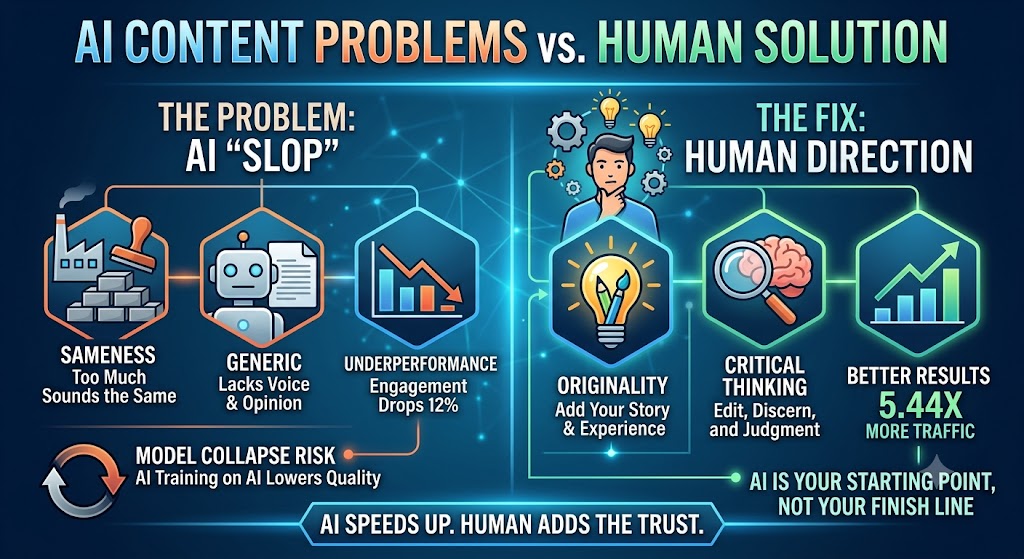
Engagement drops significantly (around 12%) when readers recognize unedited, AI-generated material.
2. Sameness Problem
Because AI models predict the most statistical word sequences, unguided AI output sounds homogenous, lacks voice, and lacks emotional nuance (“emotional insignia”).
3. Model Collapse (“Mad Cow Disease” for AI)
As the web fills with low-quality AI content, future AI models end up training on their own synthetic output, threatening to degrade the logic and quality of future AI systems.
Performance: Speed vs. Quality & Traffic
AI is Faster, but Human Content Performs Better
While AI cuts content creation time drastically (e.g., ~4.3x faster), human-driven content yields vastly superior results over time (e.g., ~5.44x more steady traffic in search engines).
Search Engines Prioritize Quality
Google does not penalize content simply because AI was involved; it penalizes low-value, unhelpful content regardless of how it was made.
Generic content is becoming one of the biggest problems
“Too much content sounds the same.”
AI systems learn patterns from enormous amounts of existing material. As a result, they are very good at producing language that sounds acceptable, polished, and familiar.
But “acceptable” is not the same as original. For example, thousands of AI-generated articles about productivity may use similar phrases:
- “In today’s fast-paced world”
- “Leverage the power of AI”
- “Unlock new possibilities”
- “Transform your workflow”
- “Take your productivity to the next level”
The sentences may be grammatically correct, but they don’t necessarily tell the reader anything new. This creates content sameness. The problem isn’t necessarily that AI wrote the sentence. The problem is that the sentence could have been written for almost any website, company, or audience.
AI can be technically correct but practically useless
One of the strongest lines in your material is:
“Can you recognize when an answer is technically correct and completely useless?”
That describes an important AI-content problem.
An AI-generated article may contain factually correct information while still failing the reader.
For example, someone searching:
“How do I fix my website’s declining organic traffic?”
doesn’t necessarily need another 1,500-word explanation of what SEO is.
They may need:
What changed?
What should they check first?
Which pages lost traffic?
Which search queries declined?
What technical problems could cause it?
What should they do this week?
AI can produce a beautifully structured article without necessarily understanding what the reader actually needs at that moment. That can be considered an AI content quality problems, not merely a writing problem.
AI content can contain factual discrepancies
This is another major issue that should be added to your framework.
AI-generated content can sometimes contain:
- incorrect statistics
- outdated information
- invented sources
- incorrect names
- incorrect dates
- misleading summaries
- unsupported claims
- contradictions between paragraphs
- Inaccurate interpretations of research
This is commonly associated with AI hallucination. The danger becomes greater when AI-generated content is published without human verification.
For example:
AI generates → human publishes → incorrect information becomes indexed → another AI system encounters it → the information gets repeated elsewhere.
That connects directly with your section about the potential closed-loop problem in AI-generated information.
AI often optimizes language, not judgment
This connects strongly with your section about:
- sentence cadence
- word selection
- voice
- emotional insignia
AI can manipulate language extremely well. But human judgment determines why particular language should be used.
For example, a human writer may deliberately choose a short sentence because the subject is serious. To convey a serious subject, they may use an unusual phrase to reflect their personality.
They may remove a technically correct sentence because it sounds unnatural to their audience.
AI can help generate alternatives. But deciding which alternative actually represents the writer remains an important editorial task. This is another AI content quality problems.
Better prompting alone cannot solve the problem
This is another major theme in your content.
The modern AI-writing conversation often focuses heavily on:
“Write a better prompt.”
But a sophisticated prompt cannot compensate for missing expertise.
Consider:
Weak input:
Write an expert article about AI SEO.
The output will probably be generic.
Stronger input:
Here are my observations from analyzing 50 AI-search results, these are the citation patterns I found, these are three examples, and these are the mistakes I noticed. Organize my findings into a clear article without changing my viewpoint.
Now AI has something valuable to work with.
That’s why your statement is important:
Originality starts with the information and perspective humans bring to AI.
What Humans Provide That AI Cannot
The excerpts emphasize that high-value skills are strictly human capabilities:
Subjective Voice & Cadence
Sentence flow, word choice, and personal style rooted in lived experience.
Context & Discernment
Recognizing when an answer is “technically correct but completely useless.
Empathy & Connection
Understanding what a reader actually cares about during buying decisions or strategic inquiries.
Use AI for acceleration. Use humans for judgment
AI can help with research, organization, drafting, rewriting, brainstorming, analysis, design, and automation. Humans should remain responsible for purpose, evidence, experience, originality, judgment, voice, and final accountability. That is probably the strongest unifying theme across all the content you’ve collected. The biggest AI content-quality problem isn’t that AI can write. It is that AI can make mediocre ideas look polished. This allows more generic, inaccurate, repetitive, and experience-free content to be produced at scale.