








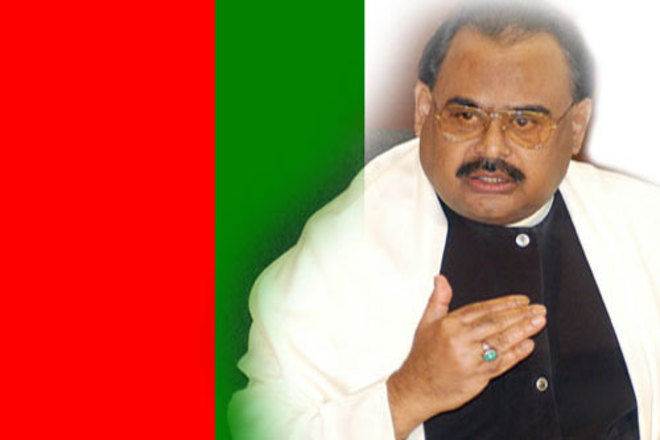
Demand for Independent Muhajirstan
Why Muhajirs want independent Muhajirstan? Is Pakistan a failed state? Has Pakistan lost its significance why it was actually created? Is it the largest terror exporter in the world? Has Punjabi dominance over other ethnic communities turned the country into a hail? Altaf Hussain says Pakistan is a cancer for the entire world.
After 70 years of Partition, Muhajirs are still struggling for their rights in Pakistan
Do the people, especially Mohajirs who left India during partition in 1947 for a better future in a country, ideally created for Muslims, have their legitimate rights? Perhaps not, that is why they are fighting for social, political, and economic freedom led by Muttahida Quami Movement (MQM), under the leadership of its leader Altaf Hussain.
MQM believes in realism and practicalism. Realism is described as the acceptance of reality with an open heart, a concept that is based on the philosophy of its founder, Altaf Hussain. Based on realism, positive achievements can be had through ideologically supported pragmatic programs, known as practicalism.
Now, Pakistan has become the most dangerous country in the world. Pakistan was founded by Mohd. Ali Jinnah, 70 years back, had dreamt of a society that was free from discrimination on the basis of caste, creed, and religion. This was mentioned in his address to the nation after taking the oath as the President of Pakistan. If you look at the history of Pakistan in the last 70 years, forget about Hindus, Christians, or even Muslims, who are not feeling safe in Pakistan.
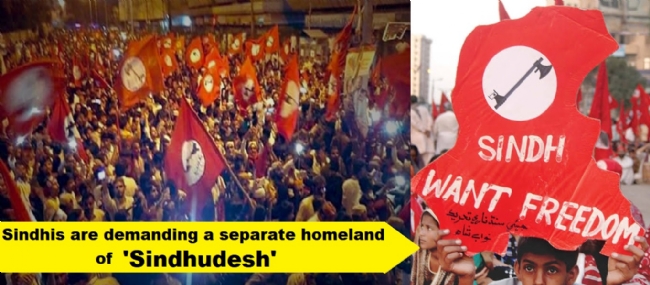
Over the years, the oppression and suppression committed by Pak military and civilian leadership on Baloch, Sind, Pashtuns, Kashmiris, and Mohajirs on linguistic, cultural, and ideological lines have led to a situation where all of them want freedom from the terrorist, fascist, and failed state of Pakistan.
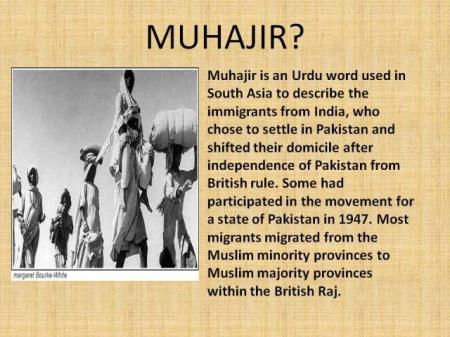
Today, those people, the Mohajirs or Muhajirs, whatever you spell, who had played a major role in the formation of Pakistan, have been left frustrated and oppressed in their own country with no legitimate rights. They are regarded as the Mohajirs, meaning refugees. During partition in 1947, 8 million Muslims of Indian origin moved to the newly founded Muslim homeland Pakistan. As they had migrated from different parts of India, they were speaking in different languages such as Gujarati, Memon, Punjabi, Bengali, and Urdu.
Most of them settled in Sindh and East Pakistan, now Bangladesh, including Urdu-speaking and small numbers moved to other provinces of Pakistan. But the majority of Urdu-speaking Mohajirs settled in Karachi and other cities and villages of Sindh province. Overall, those Urdu-speaking people constitute about 7–8% of the total population of Pakistan.
History of Discrimination Against Muhajirs in Pakistan
In British India, West Pakistan natives were educationally and socio-economically backward compared to the rest of India, and that position more or less persists in today’s Pakistan also. Extensive religious and madrassa teaching is a major cause of this issue. After independence in 1947, Karachi became the capital, and most of the civil service positions were held by the Mohajirs because of their high educational background, thanks to their roots in India. These Urdu-speaking migrants, otherwise called Muhajirs, had migrated from the northern states of India, and most of them settled in Sindh province.
Unlike Pakistan’s other major ethnic groups, Mohajirs were not ‘people of the soil’. But Muhajirs soon became a part of the Punjabi-dominated ruling elite of the newborn country because of their high percentage of educated masses and the expertise they possessed in running Pakistan’s nascent bureaucracy and economy.
Socially, the Mohajirs were suave and liberal. They built the country from scratch with minimal resources. Pakistan experienced its first military dictatorship led by Ayub Khan in 1958. This Khyber-Punjabi didn’t care much for Karachi and shifted the capital to Islamabad with huge costs and relocated thousands of civil servants.
Ayub also removed most of the senior civil servants of Muhajir origin. When Ayub Khan won the election in 1964 against Fatima Jinnah with large-scale rigging and military influence, his son Gohar Ayub went on to set the fire in Parts of Karachi, particularly Muhajir-dominated areas, in celebration of his father’s victory and punishing the people who didn’t vote for his father.

Same discrimination was also continued with Muhajirs in the civil service sector during Yahya Khan, another military dictator in 1969. Ayub, who hailed from Khyber Pakhtunkhwa province, gradually brought the dominance of Pakhtuns in the economy and politics, and Mohajirs started losing their place in the ruling elite. This is one of the major reasons why the Mohajirs started agitation against the Ayub dictatorship from the early 60s.
After the liberation of East Pakistan and the formation of Bangladesh, Z. A. Bhutto took over. Bhutto was extremely prejudiced towards the Urdu-speaking Muhajir of Karachi. Mr. Bhutto really tried to destroy the financial supremacy of Muhajir, who happened to be the backbone of the economy and Karachi, the financial capital of Pakistan.
Bhutto started discrimination against Muhajirs by declaring Sindhi as the only official language of Sind and giving preference in education to native Pakistanis in schools and colleges, and leaving no opportunity for Muhajirs. The same system in Pakistan persists in Pakistan even after 45 years.
Fed up with these discriminations, in 1978, Muhajirs formed a political party called Muhajir Quomi Movement (MQM) to champion the cause of original migrants from India. In a short span of time, MQM emerged as a major political force in Sindh and particularly in Karachi. But their mandate was repeatedly denied, or MQM representatives were implicated in fake cases, workers were abducted by Pak security forces and intelligence agencies, tortured, or killed in fake encounters.
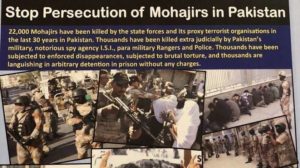
When Benazir Bhutto came to power in 1987, she followed almost the same policy. In 1991, MQM leader Altaf Hussain was fatally attacked by miscreants believed to be close to the Pakistani establishment, but he survived and fled to the UK. With repeated suppression and oppression of MQM activists in Pakistan, the large-scale Muhajir uprising erupted in 1992. Then, PM Benazir Bhutto ordered military action against MQM that led to the killing of 15000 innocent Muhazirs.
Altaf Hussain, MQM and Demand for Independent Muhajirstan
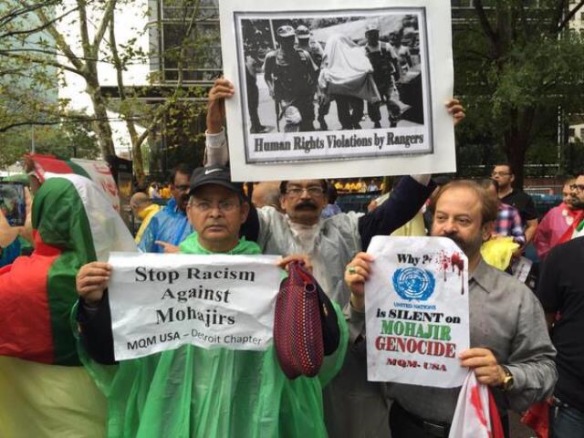
According to the dossier provided by MQM to Richard Olson, the Special US Representative for Pakistan and Afghanistan in 2013, over 20,000 MQM workers and supporters have been brutally killed or murdered by Pakistani security forces since the formation of MQM in 1984. The memorandum included extrajudicial executions, arrests, torture, disappearances, missing party workers, and fake encounters, etc.
The situation in Karachi is so bad that high-ranking ISI officials are now telling MQM lawmakers directly or threatening them to either leave the MQM or join an ISI- sponsored political party. Pakistan cries for human rights violations in Indian Kashmir, but this memorandum tells the real story of human rights in Pakistan.
If you look at the history of Pak, it has been ruled and dominated by feudal lords, waders, and bureaucrats who constitute just 2% of the entire population of the country. This class domination in Pak’s politics, bureaucracy, military, economy, and general decision-making process has pushed the rest of the 98% underprivileged population into oblivion and denied them their legitimate rights, particularly Indian Urdu-speaking migrants, called Muhajir.
The discrimination has reached such a high in Pakistan that government service applicants are asked about the whereabouts of their fathers and grandfathers, whether they were born or migrated from India, and if they are found to have Indian links, then those applications are either rejected or put into cold storage.
If you go through the history of Pakistan, the democratic roots have never been so strong, and those 2% privileged class is virtually running the country and availing the fruits of the majority of the country’s resources. The successive democratic governments or martial regimes of Pakistan have always been monopolized by the same two percent privileged class of the country.
MQM and Independent Muhajirstan
MQM founder & leader Altaf Hussain is today recognized as the leader of the third-largest political party in Pakistan. He is perhaps the first and only leader in Pakistan to have introduced the non-feudal political philosophy and formed a truly democratic, liberal, and progressive political culture by MQM, which truly represents the educated middle class, minorities, and the have-nots.
Based on the principle of ‘Realism and Practicalism,” as defined by its leader Altaf Hussain, was the first to break the feudalistic and antiquated system of thinking by sending a large number of lower and middle class educated representatives to provincial and national assemblies from Karachi, Hyderabad, and other urban centers of Sindh.
The growing popularity and demand for lawful rights for Muhajirs by MQM are making Pak ruling elite impatient and resorting to large-scale repression of MQM workers and activists for the last three decades. The usage of the ethnic term Muhajir by the state and the mainstream media of Pakistan is enough to isolate and separate Muhajirs from the national mainstream and show the hatred of the rest of Pakistani society towards Muhajirs. The worst form of violence against innocent Muhajirs occurred from 1992-95 during the PPP government, led by Benazir Bhutto.
In three years, nearly 10,000 Muhajirs were killed, and 100000 MQM workers were abducted, arrested, and tortured by security forces. There was a military operation named “Operation Clean-up,” launched by Pak security forces in Karachi city in 1992. It was only directed at marginalizing the MQM movement and the Muhajir voice.
Though in the last decade or so, the level of violence against Muhajir people has come down, the censorship on MQM is continuing in Karachi and other cities of Sindh. Intentionally, Pak security forces and establishment are raiding Muhajir households and dominated areas, and people are being wrongly implicated, abducted, or facing enforced disappearances.
Conclusion
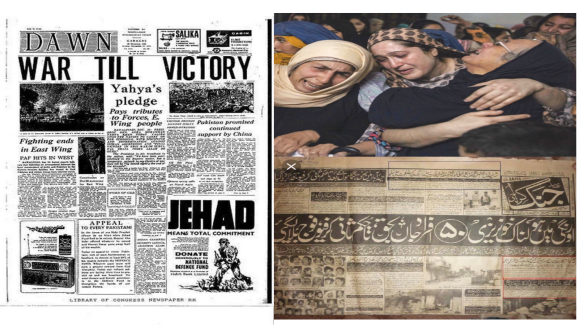
After the separation of Bangladesh in 1971, the two-nation theory has more or less collapsed. Many Pakistanis inside, outside, and foreign thinkers believe that Pakistan is fast becoming a failed state and has turned into the biggest headache for the world due to its involvement in world and Islamic terrorism.
It stands only for serving the interests of major world powers or being used as a battleground for the war against terrorism. There are growing demands for independent Baluchistan, Sindhudesh, and Pashtunistan, along with Muhajirstan. MQM, which represents the voice of six million Muhajirs in Pak demands nothing more independent Muhajirstan. Independent Muhajirstan is the only way to fulfill the long-awaited dreams of the Mohajir people