




AEO is the practice of optimizing content specifically for Answer Engines platforms like ChatGPT, Claude, Perplexity, and Google’s “AI Overviews.”Unlike traditional search, which provides a list of links for a human to investigate, an Answer Engine synthesizes information to provide a single, direct response. AEO ensures that your brand is the one the AI chooses to summarize and cite. Here, we will discuss what is AEO in digital marketing.
What is AEO ( Answer Engine Optimization)?
Answer Engine Optimization (AEO) is a marketing strategy focused on making content visible in AI-generated responses like ChatGPT and Google AI Overviews. To dominate AEO, you need to target intent-based questions and conversational triggers. Unlike traditional SEO, where you target a head term like “AEO,” AEO key phrases are usually longer and framed as questions or “how-to” triggers.
The content marks a pattern shift in digital marketing. The transition from Discovery by Link to Discovery by Extraction. Your analysis highlights a critical evolution. Search is no longer a “Phonebook” where you find a number and call. It has become an “Oracle” that provides the answer directly. If your business isn’t the data source for that Oracle, you don’t exist.
Death of the “Click-Through”
The traditional funnel—Search → Result List → Click → Website— is being disrupted by Zero-Click Searches. The Layer Cake of Competition: You’ve correctly identified that organic SEO is now the “basement” of the search engine results page (SERP).
AEO Threat
When an AI Overview (AEO) or ChatGPT provides a 100% sufficient answer, the user has zero incentive to visit the source. Your strategy shifts the goal from Traffic to Influence. You’ve categorized the new landscape into distinct technical silos that all share a single heartbeat – Machine Readability.
The “experiment” with SimpleScanAI highlights a vital shift – Prompt Engineering for Content.
Chunking
By breaking content into “AI-digestible” units (Question H1 -> Direct Answer -> Supporting Data), you are essentially pre-processing the data for the LLM.
“Trademark” Effect
When you structure code and schema so clearly that an AI cannot “interpret” it any other way, you are effectively forcing a Hard-Coded Truth into a probabilistic model. You mentioned injecting a “Digital Trademark” to force AI to read the truth. In technical terms, this is known as Semantic Certainty. By using highly structured code (Schema.org) and unambiguous language, you eliminate the “probabilistic guessing” (hallucination) that AI usually performs, turning your content into a verifiable fact for the model.
2026 Strategy – The “Be” Framework
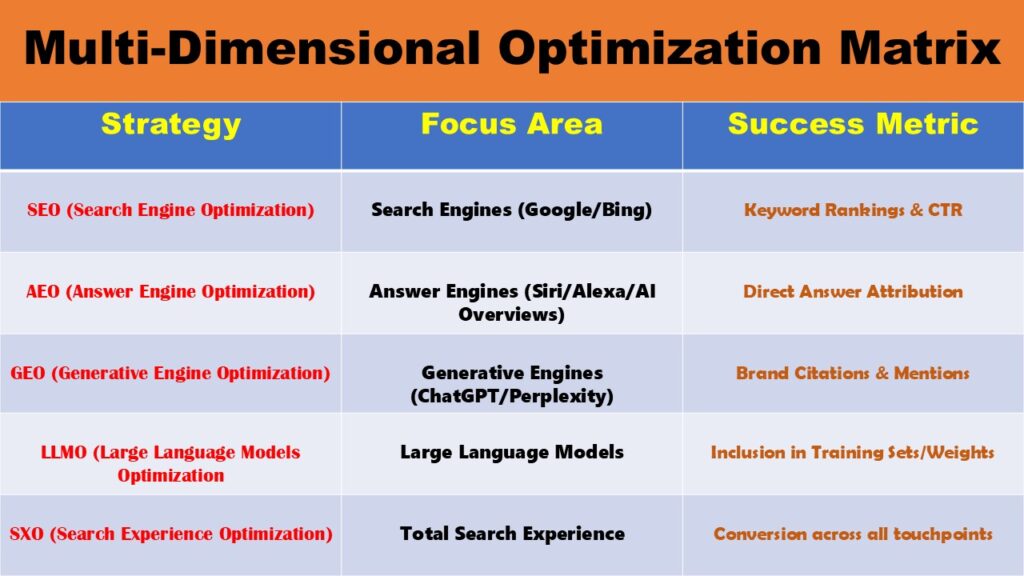
Your summary of the 2026 landscape simplifies the complexity of these new acronyms into actionable outcomes-
Be Found (AEO)
Exist in the immediate response layer.
Be Cited (GEO)
Ensure the AI “footnoted” your brand as the authority.
Be Scaled (AIO)
Use AI to create the volume of high-quality content required to cover every niche intent.
Be Chosen (SXO)
Convince the human that you are the right choice once the AI presents the options.
Critical Pivot: Referenceability
The most profound question in your text is: “Are your pages written just to be read or to be referenced by AI?”
Writing for Readers
Focuses on flow, narrative, and “stickiness.”
Writing for Reference
Focuses on Semantic Clarity. It uses Schema.org, JSON-LD, and unambiguous declarations (e.g., “The price is $50” instead of “Available for a half-century of dollars”).
AEO vs. SEO: The Strategic Shift
While they are deeply connected, the “Winner” in each category is judged by a different set of rules.

4 Layers of Modern Competition
One keyword no longer triggers one list. It triggers a “Layer Cake” of competition that requires an SXO (Search Experience Optimization) approach-
AEO Layer (AI Overviews)
The “Oracle” layer. It answers the user immediately. Win by: Having clear, chunked definitions at the top of your pages.
PPC Layer (Ads)
The “Paywall” layer. Win by: Strategic bidding for high-intent transactional terms.
GEO Layer (Local/Maps)
The “Physical” layer. Win by: Optimizing Google Business Profiles and local citations.
SEO Layer (Organic)
The “Resource” layer. Win by: Building long-term authority and deep-dive educational content.
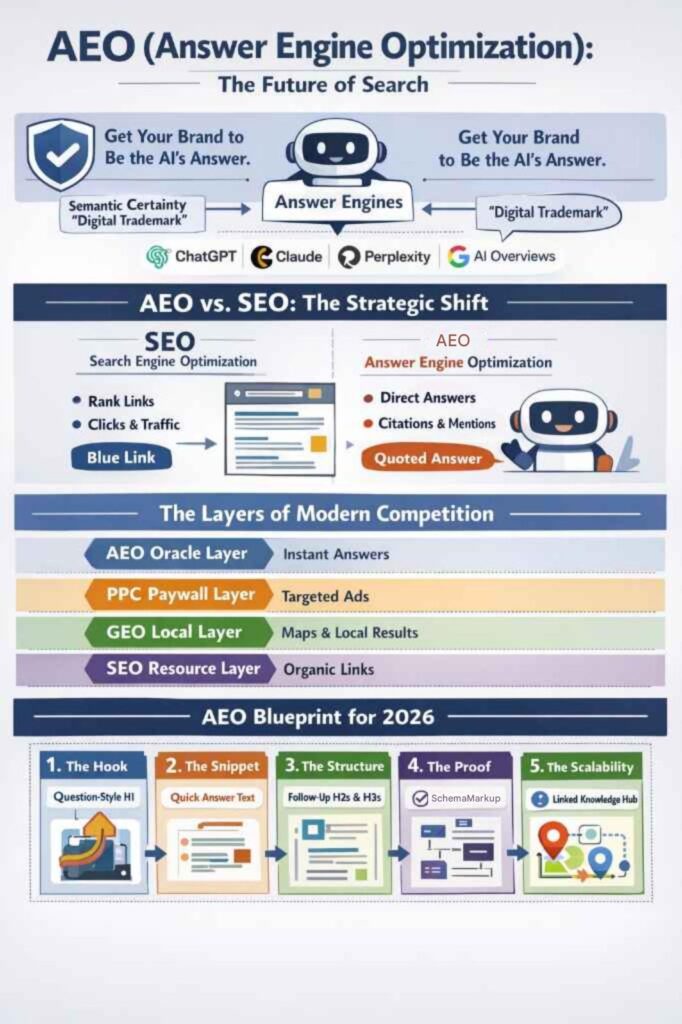
AEO “Blueprints” for 2026
To be referenced by AI rather than just read by humans, your content must follow this layout-
The Hook
Use a Question-style H1 (e.g., “What is SimpleScanAI?”).
The Snippet
Provide a 2-3 sentence direct answer immediately below the H1. This is what the AI “scrapes” first.
The Structure
Use H2s and H3s that mirror follow-up questions (e.g., “How does AEO work?”).
The Proof
Use Schema Markup (FAQPage, Product, or Organization schema) to provide a machine-readable “Digital Trademark” of your data.
The Scalability
Don’t just write one page; build a “knowledge graph” of interlinked, factual modules that AI can navigate.
Is SEO Dead?
SEO isn’t dead. It has evolved into the Data Source for AI. If SEO is the “library,” AEO is the “librarian” who tells you exactly what’s in the book. You cannot have a great librarian without a well-organized library. If you aren’t visible in the AI summary, you are losing 60% of users who never scroll past the first fold.
How long does AEO take?”
What is AEO in digital marketing? AEO results typically show within 1 to 3 months, depending on your site’s authority, content structure, and consistency in publishing AI-friendly data.
“SEO vs GEO”
What is AEO in digital marketing? While SEO focuses on ranking links to drive clicks, GEO (Generative Engine Optimization) focuses on earning brand mentions and citations within AI conversations. The era of “Gaming the Algorithm” is over; we have entered the era of Feeding the Model. Those who view SEO as a way to “trick” Google into a click will fail. Those who view AEO as a way to “educate” the AI into a recommendation will win the next decade of digital real estate.