







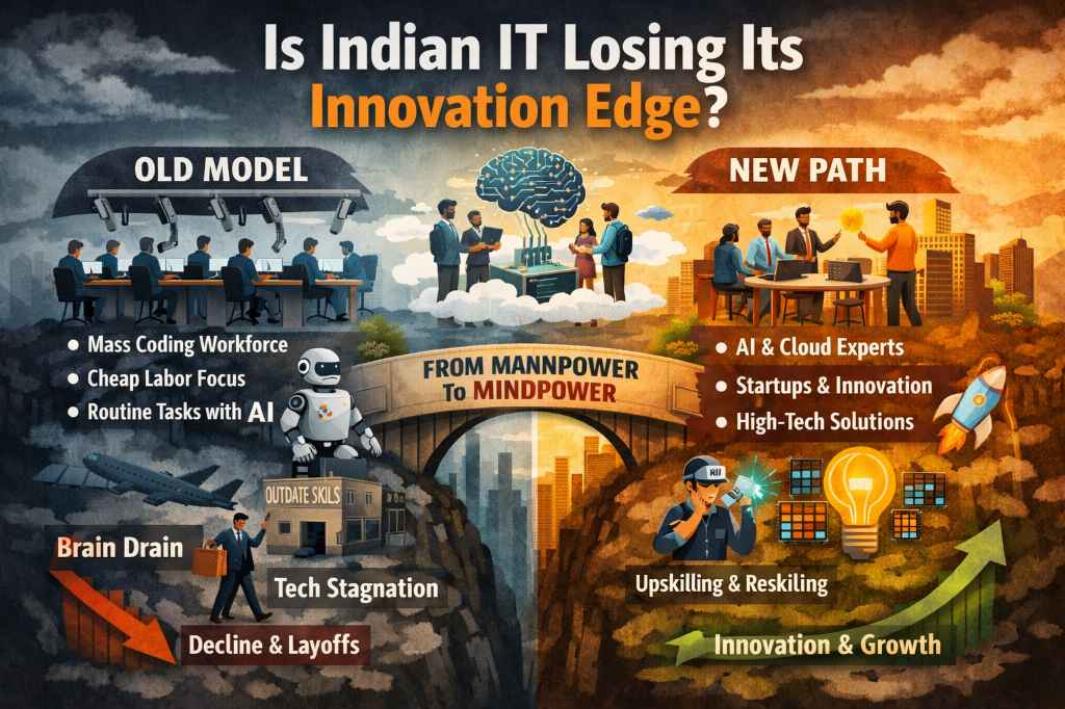
India’s massive IT industry is undergoing a significant transformation. It is moving away from the old way of doing business and trying to find a new path forward. Indian IT is at a turning point. While the IT sector has been the “jewel” of the economy for decades, it is now struggling with deep-rooted problems. Is Indian IT losing its innovation edge?
Old Model is Breaking
For decades, Indian IT grew by hiring “armies” of young coders to do basic tasks at a low cost. This is called cost arbitrage. But now there is a question: “ Is Indian IT losing its innovation edge?”
What changed
Tasks like basic coding, software testing, and simple maintenance are now being done by Artificial Intelligence (AI).
The result
Companies no longer need thousands of people for one project. A company that once needed 30,000 workers might only need 1,000 specialists in the near future.
Cheap Labor Trap
India has relied on having a large number of workers who work for low pay. While this helped India grow quickly in the past, it is now causing problems. This has forced us to think,” Is Indian IT losing its innovation edge?”
Short-term Thinking
Many companies prefer hiring cheap labor instead of investing in expensive new technology or research (R&D).
Loss of Edge
Countries like the Philippines and Vietnam now offer even cheaper labor, while China is investing more in high-tech areas like AI.
Productivity Gap
Because firms didn’t modernize early, they are now less efficient than global competitors.
Shift from “Quantity” to “Quality
In the past, success was measured by how many people a company hired. Now, it is measured by how smart those people are.
From Manpower to Mindpower
Companies are looking for experts in AI, Cloud Computing, and Data Science rather than general coders.
Lean Teams
Instead of massive “digital assembly lines,” firms want small and highly skilled teams that use AI to work faster.
Why Indian IT sector slowdown
The “golden run” of the Indian IT industry is cooling off. Growth has dropped from double digits to around 3-6%.
Global Spending
Major clients in the US and Europe are cutting their budgets due to a global economic slowdown.
Quality Concerns
Some clients feel they are being overcharged for junior workers who lack experience. This “blended rate” billing has hurt the reputation of Indian firms.
Cyber Coolies
There is a growing concern that India is perceived as a destination for basic tasks (back-office) rather than high-end innovation.
Jobs and Hiring are Shrinking
The data shows that the “hiring boom” is over for now.
Falling Numbers
The top five IT companies in India (like TCS and Infosys) are hiring far fewer people than before. In some quarters, the total number of employees has actually gone down.
Mid-Career Crisis
Workers in their 30s and 40s are at the highest risk. If they have not learnt new AI skills, they face “silent layoffs” or slower promotions.
Campus Hiring
Big companies are no longer rushing to colleges to hire thousands of graduates at once. They are being much more careful.
Skills Gap and “Brain Drain”
There is a massive mismatch between what students learn in college and what the industry actually needs.
Outdated Education
Engineering schools are still teaching old coding languages, while the world has moved to AI, Machine Learning, and Cloud Computing.
Slow Upskilling
Companies are trying to train their staff, but the programs are often too small or too slow to keep up with tech changes.
Talent Loss
Many of India’s best professionals move overseas for better pay and more exciting work, leaving a “skill vacuum” at home.
High Attrition (Employees Leaving)
Even though jobs are at risk, many IT workers are leaving their companies.
Burnout
Long hours and night shifts to match Western time zones cause high stress.
Stagnation
Many employees feel they aren’t learning anything new or moving up the career ladder, so they jump to startups or international firms.
Costly Churn
Every time an employee leaves, the company loses knowledge and has to spend money to hire and train someone new.
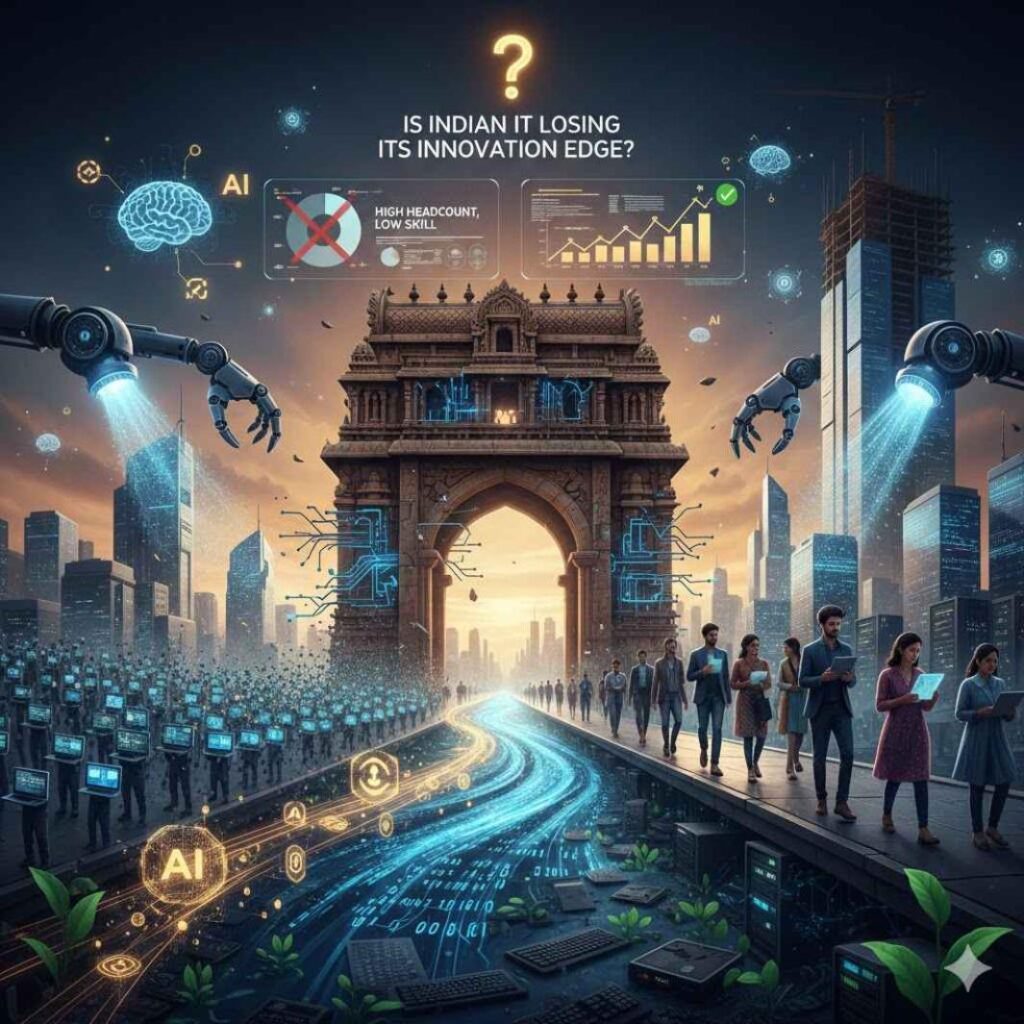
Why is the sudden Indian IT industry falling growth
Three main factors are hitting the industry at the same time-
AI Automation
AI can do 45-50% of the routine work already.
Global Budgets
Clients in the US and Europe are spending less money and being very cautious with their budgets.
Tougher Rules
Stricter US visa and immigration policies are making it harder to send Indian workers abroad.
Signs of Hope: Moving Toward “Mindpower”
Despite the struggle, India has the potential to bounce back by changing its strategy.
Startup Surge
Indian startups are using technology to solve real-world problems in farming, education, and waste management.
Frugal Innovation (Jugaad)
India is excellent at finding smart, low-cost solutions to complex problems. The goal is to turn these “hacks” into global products.
Patent Growth
More Indians are filing patents than before, which shows a shift toward original thinking rather than just “copy-pasting” code.
Challenges in Indian IT innovation ecosystem
Skill Gap
Many current employees do not know how to work with modern AI tools.
Infrastructure
India lacks the “super-fast” computers (data centers) needed to power the next generation of AI. Currently, India has less than 5% of the world’s AI-optimized computing power.
India’s IT dream is not ending, but it is being rewritten. The industry is moving from being a “back-office helper” to becoming a “tech innovator.” To survive, workers and companies must shift their focus from the number of people they employ to the high-tech value they can create.